Memory and retrospective happiness
The ReaderMemory and retrospective happiness is the novel’s account of how remembered joy changes when later experience alters what the past means. Through Michael Berg’s recollections of his illness, his relationship with Hanna, and the trial, happiness appears neither wholly false nor securely preserved: it was lived, yet memory cannot keep it untouched by its ending or by truths disclosed afterward.
Happiness and hindsight
Looking back on the weeks when he was happy with Hanna, Michael wonders whether sadness comes from yearning for past happiness, from knowing what followed, or from discovering that what emerged later had been present all along. The memory is complicated rather than erased: he recalls working intensely and passing his class while the relationship seemed to make nothing else matter. But knowledge of the later revelation changes the frame through which he sees those weeks. Retrospection does not merely add a tragic ending to a settled happy story; it unsettles the meaning of happiness itself.
Michael tests that problem against the imagined case of a long marriage later altered by the discovery of a partner’s longstanding affair. The comparison asks whether a painful revelation makes earlier happiness impossible, or whether happiness can be real even when it does not last. He refuses an easy resolution. The memory of joy may turn bitter because the ending was unhappy, but he also questions whether an ending can invalidate what was genuinely experienced. What remains uncertain is whether happiness can be remembered as true when later knowledge exposes pain that had been conscious or unconscious at the time.
His remembered younger self intensifies the question. At school, he disliked his appearance, clothes, movements, achievements, and sense of worth; his suits had been handed down by a wealthy uncle and altered by his mother. Yet alongside that insecurity he recalls an abundant belief that life would make him handsome, clever, admired, and superior. In retrospect, the sadness lies partly in the gap between that eager promise and the life that could not fulfill it. Seeing similar anticipation in children and teenagers renews the same grief: memory preserves not only past circumstances but also the future that the young self expected.
Private images and recurring memory
Michael describes certain recollections of Hanna as pictures stored away and projected again on a mental screen. They return after long intervals when he has not consciously thought about them, and he sometimes runs them through his mind repeatedly. Among them is Hanna in his father’s study, tracing the books on the shelves with a finger before turning toward the window. The image is precise and enduring, but its persistence does not make it self-explanatory. It becomes one of the fragments through which a later Michael tries to understand the earlier relationship.
The recurring pictures acquire a different force after Michael learns what Hanna’s past concealed. Images of their intimacy and everyday life no longer remain separate from images of the camps. He recognizes that his imagined scenes of Hanna as a perpetrator are clichés, unfair to the woman he had known, yet they remain powerful enough to undermine his actual memories and merge with his pre-existing images of the camps. Memory here is neither a stable archive nor a transparent reconstruction: competing pictures overlap, each changing how the other can be seen.
The novel makes this instability structural. The adult narrator repeatedly moves between the younger self’s immediate experience and the later knowledge that gives it a different significance. A happy recollection can appear vivid while its interpretation remains unsettled; a remembered detail can survive unchanged while the person who recalls it can no longer experience it as he once did. The distinction between what happened and what Michael can now feel about what happened becomes central to the account of retrospective happiness.
Illness, desire, and remembered beginnings
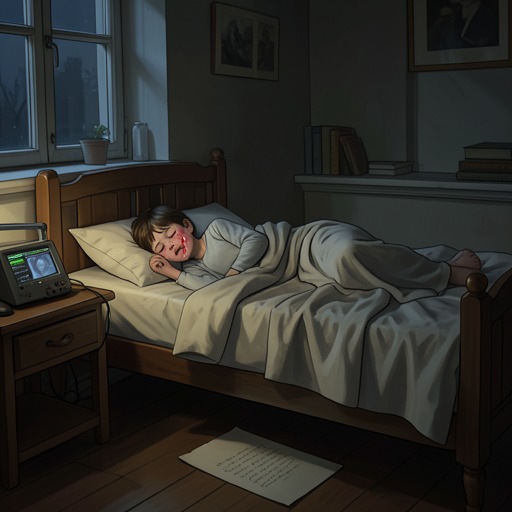
The story’s earliest recollections establish memory as bodily and temporal before it becomes historical. At fifteen, Michael contracts hepatitis, which lasts from autumn until spring and leaves him weak and ashamed of his illness. As he begins to recover, his mother moves his bed onto the balcony; the change gives him access to the sky, sunlight, clouds, and the sounds of children in the courtyard. His memory of recovery is anchored in particular circumstances, including a blackbird singing one February evening.
His first outing takes him back to Bahnhofstrasse, where, the previous autumn, he had become sick on the way home from school. A woman helps him clean himself and takes him home. After the doctor diagnoses hepatitis, his mother expects him, once recovered, to buy flowers and thank the stranger. That practical obligation leads him back to her door. The encounter, initially remembered as an act of care during illness, becomes the beginning of a relationship whose significance Michael cannot yet know.
During his convalescence, the sickroom forms a world of its own. Books, fever, sleepless nights, and the surrounding room shape a vivid inner landscape; as the illness recedes, that imaginative enclosure fades, but a sufficiently long illness leaves the recovering child feeling caught in it. Michael’s later account links this period of suspension to his early longing for Hanna. The next night after their first sexual encounter, he falls in love, yearning for her and dreaming of her. In retrospect, he wonders whether loving a woman after intimacy is a way of feeling obliged to repay what he has received. That later self-questioning makes the beginning of the relationship another memory whose emotional meaning is not identical to the young Michael’s experience.
Historical images and the trial
The trial extends the problem of retrospective memory from private life to historical understanding. During its weeks, Michael says that his feelings are numb. He recalls Hanna’s familiar physical details, but those recollections feel detached from the feelings they once carried. The comparison he uses is to an arm numbed by an injection: the mind can register that something is happening before sensation returns, and the return of color does not restore feeling. He experiences this distance beyond the courtroom as well, watching himself function among family, friends, and university life without inward involvement.
He also observes numbness taking hold among those who attend the trial. Judges and lay members first react visibly to accounts of camp horrors; later, their faces return to normal, and they can show impatience when a witness loses the thread. Students who attend only weekly are horrified anew on each visit, while Michael, present every day, observes them with detachment. Repetition alters what can be felt: the same testimony that initially shocks can become part of the routine of hearing it. Michael’s account does not treat this habituation as a simple resolution; it leaves him troubled by the way perpetrators, victims, and later generations can all be drawn into the dulling effects of repeated exposure.
The images available to him also shape what he can remember and imagine. Michael recalls the Auschwitz gate, wooden bunks, collections of hair, spectacles, and suitcases, the entrance to Birkenau, and photographs of corpses at Bergen-Belsen. He notes that survivor testimony published soon after the war disappeared from publishers’ lists for years. Later television and films, including the series Holocaust and the films Sophie’s Choice and Schindler’s List, made the camp world more accessible to collective imagination, but also supplemented and embellished it. In the earlier period, a limited set of photographs and testimony returned repeatedly until the images froze into clichés. His private pictures of Hanna and his inherited historical pictures therefore meet in an imagination already shaped by the circulation, scarcity, and repetition of public images.
Distance, return, and the limits of recollection
When Hanna leaves the city, Michael gradually stops watching for her everywhere and changes his routes to avoid her building. The memory recedes without disappearing. He compares its persistence to a city left behind by a departing train: still somewhere behind, and in principle recoverable, but no longer accompanying him at every moment. His account of his school and university years as happy is similarly uncertain. He remembers those years as easy, yet has few memories of them; on closer inspection, painful and embarrassing situations return, and he recognizes that he had not overcome his earlier relationship.
He retrospectively connects that unresolved experience to a posture of distance. He behaved with arrogant superiority, as if nothing could touch or confuse him, and avoided involvement. This stance is not presented as a conclusion he had consciously formed at the time. Instead, the adult narrator identifies it as a pattern that helps explain why an apparently light period left such a small and questionable bundle of memories. Remembering is also a means of recognizing what the younger self could not name.
Michael later goes to Struthof, hoping that direct experience of a former concentration camp will displace the clichés in his imagination. Afterward, the impressions join his existing images of Auschwitz and Bergen-Belsen and freeze with them rather than bringing the camp world closer. The attempt shows the limits of retrospective correction: new experience can enter memory without undoing the established pictures through which the past is understood. Across the novel, memory keeps returning, but return is not the same as recovery. Happiness survives as an experience Michael once had; what it can mean in retrospect remains changed by loss, revelation, repeated images, and the unresolved distance between understanding and feeling.